
What Size Dehumidifier Do I Need?
Find the right dehumidifier size for your room, basement, crawlspace, or home using current ENERGY STAR guidance for square footage, humidity, temperature, and moisture conditions.
Editorial Sizing & Research Standard
Our calculations and equipment sizing methods draw directly from published engineering principles, manufacturer technical data, and industry standards.
Learn more in our Editorial Policy.
Choosing the right dehumidifier size isn’t as simple as grabbing the largest box on the store shelf or following a generic “pints per square foot” formula.
Selecting an undersized unit means it will run continuously without reducing relative humidity to healthy target levels, wasting electricity and risking mold growth. On the other hand, buying an oversized unit for a small room can cause short-cycling, excessive noise, and unnecessary upfront cost.
To choose the correct equipment capacity, you need to match standardized moisture-removal capacity—measured in pints per day (PPD)—against your space size, untreated relative humidity, operating temperature, and physical moisture conditions.
This guide explains how current ENERGY STAR sizing guidance works, how testing standards changed in recent years, and how to select equipment for rooms, basements, crawlspaces, and whole-home systems.
Calculate Your Space Instantly
Want to find your recommended capacity right now? Enter your floor area, ceiling height, relative humidity, operating temperature, and moisture conditions into our free sizing tool.
1. How Dehumidifier Capacity Is Rated (PPD)
Residential dehumidifiers are sized by pints per day (PPD). This number measures how many US liquid pints of moisture the equipment extracts from ambient air during 24 hours of continuous operation under standardized test conditions.
Standardized Test Rating Conditions
Moisture extraction rates depend heavily on ambient room temperature and relative humidity. To ensure fair comparisons, the U.S. Department of Energy (DOE) establishes standardized rating standards under 10 CFR Part 430, Subpart B, Appendix X1:
- Portable Dehumidifiers: Tested at 65°F (18.3°C) and 60% Relative Humidity.
- Whole-Home Dehumidifiers: Tested at 73°F (22.8°C) and 60% Relative Humidity.
Because cooler air contains less water vapor than warm air, a portable unit tested at 65°F will collect fewer total pints of water than the same unit running in 80°F air. Standardizing test conditions at 65°F reflects realistic baseline conditions found in cool residential basements and living areas.
2. Old vs. Current PPD Ratings (The 2019 Rating Shift)
If you are replacing a dehumidifier purchased before 2019, you will notice that new models display lower PPD numbers for similar physical cabinet sizes.
Prior to 2019, portable dehumidifiers were tested under older laboratory conditions (80°F and 60% RH). In June 2019, the DOE updated the test procedure to 65°F and 60% RH. Because cooler test air contains less moisture, rated capacities dropped by roughly 30% to 35% across the industry without any actual loss in physical machine performance.
ENERGY STAR Old vs. Current Rating Conversion Table
To compare older units with modern DOE ratings, use official ENERGY STAR Dehumidifier Testing and Capacity guidance:
| Old Rating (Pre-2019 @ 80°F) | Approximate Current Rating (Post-2019 @ 65°F) |
|---|---|
| 30 PPD | 20 PPD |
| 40 PPD | 25 PPD |
| 50 PPD | 30 PPD |
| 55 PPD | 30–35 PPD |
| 60 PPD | 35 PPD |
| 70 PPD | 40–45 PPD |
| 90 PPD | 55 PPD |
Note: ENERGY STAR describes these figures as approximate correlations for model comparison; actual performance varies depending on space layout and operating environment.
3. Current ENERGY STAR Dehumidifier Sizing Guidelines
Official ENERGY STAR Dehumidifier Sizing Guidance establishes equipment capacity ranges based on floor area and the severity of untreated moisture conditions.
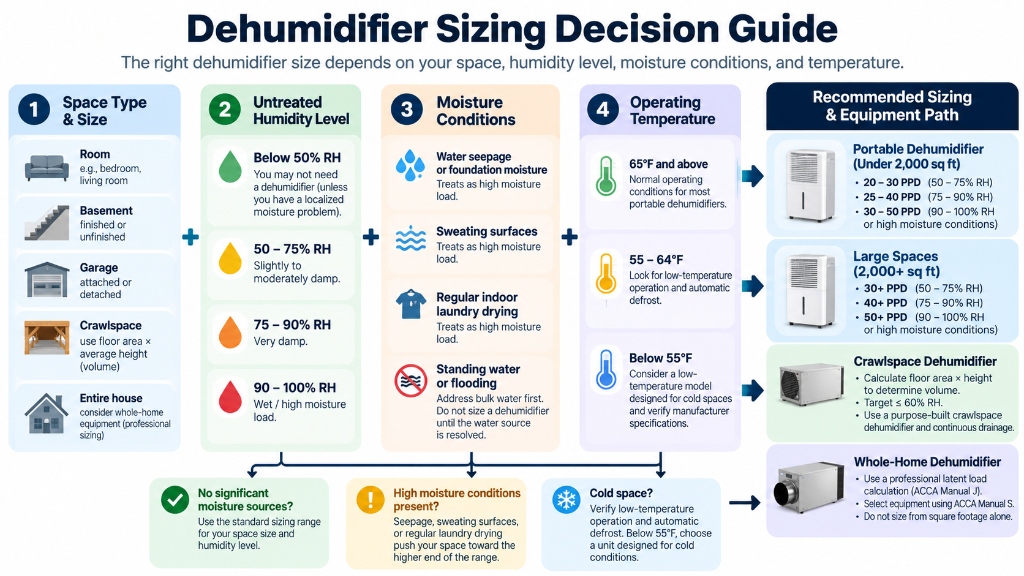
Portable Dehumidifier Sizing Table
| Space Condition | Relative Humidity / Visual Description | Portable Sizing Range (<2,000 sq ft) | Large Space Baseline (≥2,000 sq ft) |
|---|---|---|---|
| Moderate | 50–75% RH — Space occasionally feels damp or smells musty. | 20–30 PPD | 30+ PPD |
| Very Damp | >75–90% RH — Space regularly feels damp, smells musty, or shows damp spots. | 25–40 PPD | 40+ PPD |
| Wet / High Load | >90% RH — Walls/floors sweat, seepage occurs, or wet laundry is regularly dried indoors. | 30–50 PPD | 50+ PPD |
Understanding Large Spaces (≥2,000 sq ft)
For spaces 2,000 sq ft or larger, ENERGY STAR provides an open-ended minimum capacity baseline (such as 30+ or 50+ PPD) rather than a bounded upper limit. In large open areas or complex floor plans, airflow distribution, internal wall barriers, and localized moisture loads dictate whether a higher-capacity single unit or multiple distributed units are required.
4. Key Factors That Influence Dehumidifier Sizing
Floor Area and Ceiling Height
While square footage provides a floor area baseline, total air volume ($spaceVolume = floorArea \times ceilingHeight$) dictates the actual air mass a dehumidifier must process. Standard residential sizing assumes an 8-foot ceiling. Spaces with 10-foot, 12-foot, or vaulted ceilings contain significantly more air volume and require favoring the higher end of the ENERGY STAR PPD range.
Operating Temperature
Refrigerant dehumidifiers pull moisture from air by cooling internal coils below the dew point. When ambient air drops below 65°F, ice can form on refrigerant coils, drastically reducing efficiency.
- 65°F or Warmer: Standard portable operation.
- 55–64°F: Select equipment equipped with an automatic defrost sensor or rated for low-temperature operation.
- Below 55°F: Standard portable compressor units perform poorly. Select specialized cold-environment equipment certified by the manufacturer.
Moisture Source Control vs. Dehumidifier Capacity
A dehumidifier is designed to control ambient relative humidity—it is not a substitute for fixing structural water intrusion or plumbing leaks:
- Water Seepage & Foundation Leaks: Exterior water seeping through walls or basement floor slabs represents a severe structural bulk-water issue. Exterior site drainage, gutters, and foundation sealing must be addressed alongside dehumidification. If groundwater intrusion forces water into your basement pit during heavy storms, use our free Sump Pump Sizing Guide to calculate required pumping capacity before relying on room dehumidification.
- Active Plumbing Leaks: Repair active leaks immediately before relying on dehumidifier operation.
- Standing Water / Flooding: Standing water from recent flooding falls outside normal humidity control. Bulk water extraction and structural drying must occur before sizing ongoing maintenance equipment.
- Indoor Laundry Drying: Air-drying wet laundry indoors adds substantial moisture to room air, shifting the space into the Wet / High Load sizing tier.
5. Crawlspace Dehumidifier Sizing
Crawlspaces require a distinct sizing approach. Portable room dehumidifiers are generally unsuitable for crawlspaces due to low height clearance, cold ground temperatures, and manual bucket drainage limitations.
Crawlspace Sizing Steps
- Calculate Crawlspace Volume: Multiply crawlspace floor area by average height ($crawlspaceVolume = floorArea \times height$).
- Target Humidity: Maintain relative humidity at or below 60% to prevent wood rot and mold spores.
- Select Purpose-Built Equipment: Choose a low-profile, purpose-built crawlspace dehumidifier whose manufacturer specification covers your calculated volume under actual operating temperatures.
[!IMPORTANT] Address Moisture Entry First: Dehumidifying an unencapsulated or poorly sealed crawlspace forces the unit to continuously dry incoming outdoor air. According to U.S. EPA Moisture Control Guidance, priority must be given to bulk-water control, site drainage, installing a continuous heavy ground vapor barrier, and assessing full crawlspace encapsulation.
6. Whole-House Dehumidification
When elevated relative humidity (especially >55% RH) persists throughout an entire home served by central HVAC, a ducted whole-home dehumidifier is often the most effective solution.
Whole-Home Sizing Principles
Unlike portable room units, whole-home dehumidifiers cannot be sized from floor area alone. Equipment must be selected by an HVAC professional using standardized building science standards:
- ACCA Manual J: Calculates building latent moisture loads based on local climate design data, air infiltration, occupancy, and fresh air ventilation requirements.
- ACCA Manual S: Selects matching mechanical equipment to handle calculated sensible and latent heat loads.
If humidity issues are localized to a single room or basement level, portable units sized using the room calculator path remain the recommended approach.
7. Calculate Your Dehumidifier Size
Ready to find the exact ENERGY STAR capacity range and equipment guidance for your home?
Our free interactive calculator walks through your space type, square footage, ceiling height, measured relative humidity, temperature, and physical moisture conditions to deliver transparent sizing recommendations.
Dehumidifier Sizing Calculator
Determine required pints per day (PPD), space volume, low-temperature warnings, and continuous drainage recommendations based on official ENERGY STAR criteria.
Conclusion
Choosing the correct dehumidifier capacity protects your home’s structural integrity, indoor air quality, and comfort without wasting energy. Always shop by official current DOE-rated pints per day (PPD), operating temperature ratings, and continuous drainage features rather than unstandardized square-foot coverage claims on retail boxes.
For quick, accurate sizing tailored to your room, basement, garage, or crawlspace:
Authoritative Sources & References
- ENERGY STAR — Dehumidifiers Specification & Guidance:
https://www.energystar.gov/products/dehumidifiers - ENERGY STAR — Dehumidifier Testing and Capacity Guidance:
https://www.energystar.gov/products/appliances/dehumidifiers/dehumidifier_testing_and_capacity - U.S. Department of Energy (DOE) — 10 CFR Part 430, Subpart B, Appendix X1:
https://www.ecfr.gov/current/title-10/chapter-II/subchapter-D/part-430/subpart-B/appendix-X1 - U.S. EPA — Moisture Control Guidance for Building Design, Construction & Maintenance:
https://www.epa.gov/mold/moisture-control-guidance-building-design-construction-and-maintenance - ACCA — Technical Manual J & Manual S Standards:
https://www.acca.org/standards/technical-manuals
DwellNinja Editorial Team
Objective Homeowner Advice
The DwellNinja Editorial Team researches manufacturer documentation, product specifications, warranties, and professional guidance to produce practical homeowner guides.
Sump Pump Sizing Calculator
Skip hand math. Calculate your GPM and Total Dynamic Head in under 2 minutes.
Open Sizing Calculator →Related Guides You Might Like
What Size Window Air Conditioner Do I Need?
Find the right window air conditioner size for your room using ENERGY STAR BTU guidance, with adjustments for sun, occupancy, kitchens, and high ceilings.
Smart Thermostats: When They Actually Save Money
Look past the marketing. We analyze utility research and household HVAC habits to explain when smart thermostats deliver real savings and when they do not.