
What Size Sump Pump Do I Need?
Learn how to size a sump pump using water inflow, GPM and total dynamic head—not horsepower alone. Includes a step-by-step example and free calculator.
Editorial Sizing & Research Standard
Our calculations and equipment sizing methods draw directly from published engineering principles, manufacturer technical data, and industry standards.
Learn more in our Editorial Policy.
Choosing the right sump pump isn’t as simple as deciding between 1/3 HP and 1/2 HP.
The number that really matters is how much water the pump can move at the amount of head your discharge system creates.
In practical terms, you want to know:
How many gallons per minute (GPM) does my sump pump need to move at my home’s Total Dynamic Head (TDH)?
To answer that, you’ll measure how quickly water enters your sump pit, add a sizing margin, estimate the vertical lift and friction in the discharge piping, and then compare your requirement with the pump manufacturer’s published performance curve.
Quick answer: Don’t shop by horsepower alone. Shop for a pump that can deliver at least your required GPM at your calculated TDH.
Want your answer now?
Use our Sump Pump Sizing Calculator. Enter your sump-pit measurements, water-rise test and discharge setup, and we'll estimate the GPM/GPH your pump should deliver at your calculated Total Dynamic Head.
Why Horsepower Alone Doesn’t Tell You Sump Pump Capacity
Walk down the sump-pump aisle and you’ll see familiar motor sizes such as:
- 1/3 HP
- 1/2 HP
- 3/4 HP
- 1 HP
It’s tempting to treat those numbers as the pump’s capacity.
They aren’t.
Horsepower describes the motor. What you need to know is how the complete pump performs at a particular combination of flow and head.
Pump manufacturers publish performance curves or tables showing how much water a specific pump can move as head increases.
That’s important because pump capacity generally decreases as the pump has to move water against greater head.
For example, WAYNE publishes the following performance for two of its residential sump pumps:
| Model | Motor | At 5 ft Head | At 10 ft | At 15 ft | At 20 ft |
|---|---|---|---|---|---|
| CDU790 | 1/3 HP | 64 GPM | 51 GPM | 37 GPM | 20 GPM |
| CDU800 | 1/2 HP | 75 GPM | 64 GPM | 51 GPM | 34 GPM |
The 1/3 HP CDU790 may be advertised with a maximum flow of 77 GPM, but that occurs at essentially zero head. At 20 feet of head, the published capacity is 20 GPM.
That’s why comparing your required GPM with a pump’s maximum GPM or GPH can be misleading.
You need its capacity at your system’s head.
The Hydraulic Institute describes a pump’s head-versus-flow curve as one of the fundamental ways of representing pump performance. The operating point of a pumping system depends on the interaction between the pump and the system it is connected to.
For a homeowner, the takeaway is simple:
Find your required flow. Find your system head. Then make sure the manufacturer’s pump curve meets or exceeds that operating point.
The Three Numbers You Need
You don’t need to become a pump engineer to size a residential sump pump.
For a useful estimate, focus on three numbers:
- Measured Water Inflow
How quickly is groundwater entering your sump basin? We’ll express this as gallons per minute (GPM). - Design Flow (With 1.5× Sizing Margin)
Your measurement captures the conditions that existed while you performed the test. We apply a 1.5× sizing margin to provide additional pumping capacity above that observed inflow. - Total Dynamic Head
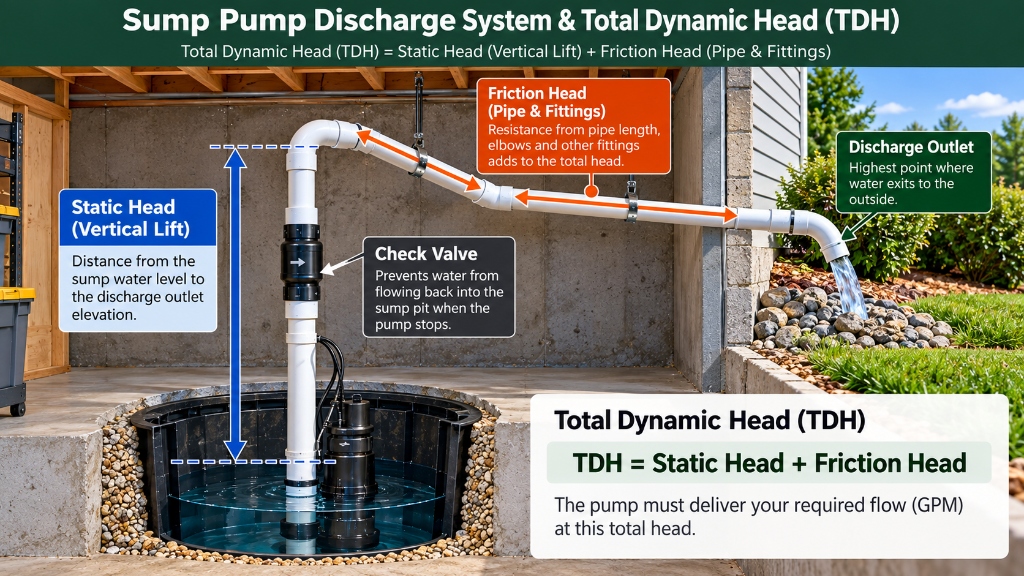
Total Dynamic Head, or TDH, estimates the resistance the pump must overcome.
For this homeowner sizing method:
TDH = Static Head + Friction Head
Static head comes primarily from lifting the water vertically.
Friction head comes from moving water through the discharge pipe, elbows and other components.
Once you have design flow and TDH, you have something useful to shop with.
Rather not calculate this by hand? The Sump Pump Sizing Calculator walks you through these measurements and performs the flow, friction and TDH calculations for you.
Step 1: Measure Your Sump Pit
Before measuring water inflow, determine how much water corresponds to one inch of water depth in your sump basin.
Most residential sump pits are roughly round.
For a round basin:
Gallons per inch = π × (Diameter ÷ 2)² ÷ 231
All dimensions are in inches.
For example, an 18-inch round sump pit holds approximately:
1.10 gallons per inch of water depth
If your basin is rectangular:
Gallons per inch = Length × Width ÷ 231
This converts a change in water level into an estimated volume of water.
Why pit size matters
Suppose the water level rises three inches.
Three inches in a narrow basin represents less water than three inches in a wide basin.
Simply timing how quickly the water rises isn’t enough. We also need to know how much water that rise represents.
Step 2: Measure How Fast Water Enters the Pit
The best measurement comes from observing your actual sump pit during meaningful groundwater inflow—ideally during or shortly after wet weather when the system is actively receiving water.
Safety first
Never reach into a sump pit while the pump is energized.
If you need to temporarily prevent the primary pump from running while measuring water rise, follow the pump manufacturer’s safety instructions and only do so if you can safely control the situation.
Do not allow the water level to approach the basement floor, electrical equipment, wiring or anything that could be damaged or create an electrical hazard.
If the water is entering too quickly to perform the measurement safely, stop the test.
Measure the rise
You’ll need two measurements:
- how many inches the water rises;
- how many seconds that rise takes.
Suppose an 18-inch round basin rises 3 inches in 60 seconds.
We already calculated that the basin holds approximately:
1.10 gallons per inch
So:
1.10 × 3 = 3.30 gallons
Because 60 seconds equals one minute:
Measured inflow ≈ 3.3 GPM
If the same basin rises 6 inches in 30 seconds:
1.10 × 6 = 6.6 gallons
Thirty seconds is half a minute, so:
6.6 ÷ 0.5 ≈ 13.2 GPM
That’s a much more demanding water-inflow condition.
Step 3: Apply a Sizing Margin
Your measurement tells you approximately how much water was entering the basin during your test.
It doesn’t tell you the maximum amount of groundwater your home could ever experience.
Rainfall intensity, saturated soil, seasonal groundwater and other conditions can change inflow.
For the DwellNinja sizing method, we multiply measured inflow by 1.5:
Design Flow = Measured GPM × 1.5
If you measured:
13.2 GPM
then:
13.2 × 1.5 = 19.8 GPM
Your design flow is therefore approximately:
19.8 GPM
This 1.5× sizing margin is a sizing assumption, not a universal building-code requirement and not a guarantee that a pump can handle every possible storm or groundwater condition.
If your basement has a history of serious flooding, unusually high groundwater, rapid inflow, multiple drainage systems feeding the basin or other unusual conditions, professional evaluation may be appropriate.
Step 4: Measure Vertical Lift
Now we need to determine how hard the pump has to work to move the water out of the house.
Start with vertical lift, sometimes called static head in a simplified residential calculation.
Measure approximately from the operating water level in the sump basin to the relevant elevation of the discharge outlet.
Suppose the water must be lifted:
10 vertical feet
Your static head is approximately:
10 ft
This is not the same as total pipe length.
A discharge pipe can travel 40 or 50 feet horizontally without adding 40 or 50 feet of static head.
That’s where friction enters the calculation.
Step 5: Account for Pipe and Fitting Friction
Water moving through a pipe encounters resistance.
Resistance increases with factors such as:
- flow rate;
- pipe diameter;
- pipe length;
- elbows and fittings;
- valves and other components.
So two homes with the same 10-foot vertical lift can still place different demands on their pumps.
Imagine two discharge systems.
System A
- 10 ft vertical lift
- 15 ft total discharge pipe
- few bends
System B
- 10 ft vertical lift
- 60 ft total discharge pipe
- multiple elbows
Both have approximately the same static head, but System B creates more friction.
Pipe diameter matters
A larger pipe generally produces less friction at the same flow rate than a smaller pipe.
That’s one reason you should follow the pump manufacturer’s discharge-pipe requirements rather than reducing the discharge pipe simply because a smaller pipe is easier to route.
Fittings matter too
Every elbow changes the direction of flow and adds resistance.
For a homeowner estimate, fittings can be represented as an equivalent additional length of pipe and included in the friction calculation.
What about the check valve?
A sump-pump check valve prevents water remaining in the discharge pipe from draining back into the basin when the pump stops.
The hydraulic loss through a check valve depends on its actual design. That’s why the DwellNinja calculator asks whether one is installed but does not silently assign a universal check-valve friction value.
Follow the pump and valve manufacturers’ installation requirements, along with applicable local plumbing requirements.
Step 6: Calculate Total Dynamic Head
Now combine static head and estimated friction head:
TDH = Static Head + Friction Head
Suppose you have:
10.0 ft static head
and:
1.6 ft estimated friction head
Then:
10.0 + 1.6 = 11.6 ft TDH
You now know both numbers required to evaluate a pump:
- Flow requirement: 19.8 GPM
- Total Dynamic Head: 11.6 ft
For shopping purposes, rounding upward gives a simple target:
Look for a pump capable of delivering at least 20 GPM at approximately 12 ft TDH.
Notice what’s missing from that statement.
Horsepower.
We haven’t needed it yet.
Step 7: Read the Manufacturer’s Pump Curve
This is where everything comes together.
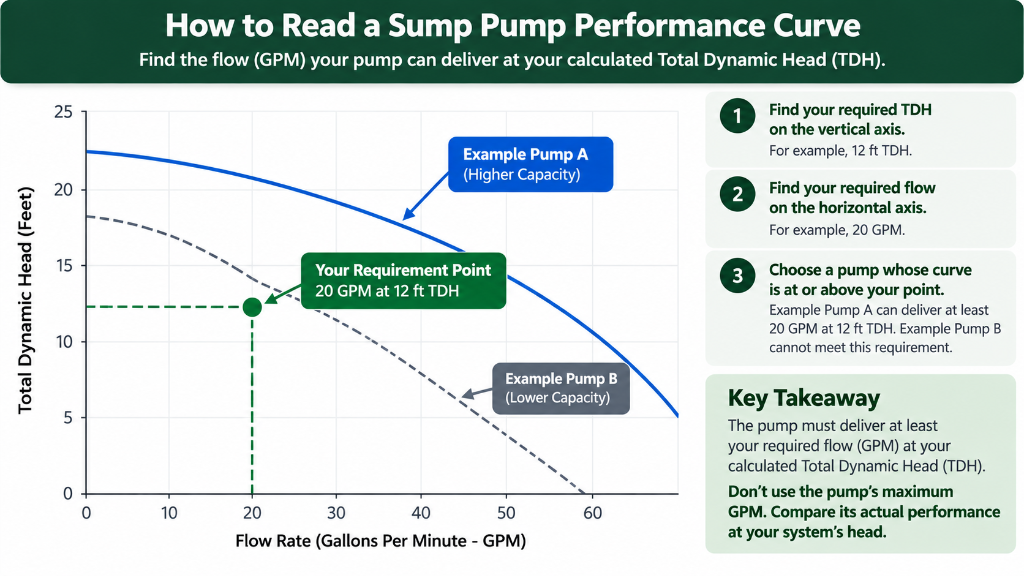
A typical sump-pump performance curve has:
- Flow on the horizontal axis.
- Head on the vertical axis.
As head increases, available flow typically decreases.
Suppose your requirement is:
20 GPM at 12 ft TDH
Find approximately 12 ft on the head axis.
Then find 20 GPM on the flow axis.
Where those values meet is your required operating point.
Now compare that point with the manufacturer’s performance curve.
If the curve is above your requirement
The pump can deliver at least the required flow at that head, based on the manufacturer’s published performance.
If the curve is below your requirement
The pump doesn’t meet your calculated requirement.
Choose another pump.
Don’t use maximum flow
This is one of the easiest sump-pump specifications to misunderstand.
A box or product page might advertise:
Maximum Flow: 4,600 GPH
That does not mean the pump delivers 4,600 GPH through your basement discharge system.
Maximum flow is generally associated with very little or no head.
For example, WAYNE publishes its 1/3 HP CDU790 at:
- 4,600 GPH maximum flow
but:
- 3,060 GPH at 10 ft
- and: 1,200 GPH at 20 ft
Same pump. Very different capacity.
Always compare performance at the head your system actually creates.
Worked Example: Sizing a Residential Sump Pump
Let’s put the complete process together.
Suppose a homeowner has:
- 18“ round sump basin
- 6“ water rise
- 30-second measurement
- 10 ft vertical lift
- 50 ft total discharge piping
- 1½“ Schedule 40 PVC
- four 90-degree elbows
Basin capacity
An 18-inch round basin holds approximately:
1.10 gallons per inch
Water entering the basin
The water rises six inches:
1.10 × 6 ≈ 6.61 gallons
That occurs in 30 seconds, or half a minute:
6.61 ÷ 0.5 ≈ 13.2 GPM
Measured inflow:
13.2 GPM
Apply the 1.5× sizing margin
13.2 × 1.5 ≈ 19.8 GPM
Design flow:
19.8 GPM
Calculate head
Vertical/static head:
10.0 ft
Estimated pipe and fitting friction:
approximately 1.6 ft
Total Dynamic Head:
10.0 + 1.6 = approximately 11.6 ft
Final shopping requirement
Round the requirement upward:
Choose a pump capable of delivering at least 20 GPM — or 1,200 GPH — at approximately 12 ft of head.
Then open the performance curve or performance table for the pump you’re considering.
If it delivers at least that much water at approximately 12 feet of head, it meets this calculated operating requirement.
That’s a much more meaningful comparison than asking only whether you need a 1/3 HP or 1/2 HP motor.
1/3 HP vs. 1/2 HP vs. 3/4 HP
Horsepower isn’t useless.
It just shouldn’t be the first or final sizing number.
Here’s a better way to think about the common residential categories.
1/3 HP sump pumps
A 1/3 HP pump can provide substantial capacity in some residential systems.
For example, WAYNE publishes its 1/3 HP CDU790 at:
- 64 GPM at 5 ft
- 51 GPM at 10 ft
- 37 GPM at 15 ft
- 20 GPM at 20 ft
Whether that’s enough for your home depends on your required flow at your TDH.
1/2 HP sump pumps
Moving to 1/2 HP can provide greater flow, greater head capability or both—but performance still depends on the specific pump.
WAYNE’s 1/2 HP CDU800, for example, is published at:
- 75 GPM at 5 ft
- 64 GPM at 10 ft
- 51 GPM at 15 ft
- 34 GPM at 20 ft
Zoeller’s 1/2 HP Model 98 is another example of why the manufacturer’s curve matters. Zoeller publishes that pump at approximately:
- 72 GPM at 5 ft
- 61 GPM at 10 ft
- 45 GPM at 15 ft
- 25 GPM at 20 ft
Its published shutoff head is approximately 23 ft.
Two pumps can therefore share the same horsepower rating without having identical performance characteristics.
3/4 HP and larger pumps
Higher-horsepower residential pumps are available for systems requiring greater flow, greater head or both.
But don’t assume that moving from 1/2 HP to 3/4 HP automatically makes a system better protected.
First calculate what the system actually requires.
Then choose a pump that meets that requirement at the relevant operating point.
The question isn’t “How much horsepower can I buy?”
It’s “How much flow do I need at my system’s head?”
Is a Bigger Sump Pump Always Better?
Not necessarily.
Your primary goal is to have enough pumping capacity to keep up with expected inflow at the required head, with an appropriate sizing margin.
Installing substantially more pump than the system requires doesn’t automatically provide better protection.
Basin size, float-switch range, inflow and pump capacity all influence how frequently a pump starts and stops.
The Hydraulic Institute also recognizes that pumps have intended operating regions and that operating away from appropriate conditions can affect efficiency and reliability.
For residential sump systems, follow the manufacturer’s requirements for:
- minimum basin size;
- float-switch clearance;
- discharge-pipe size;
- operating range;
- installation configuration.
A properly selected pump should meet your required operating point without treating motor horsepower as the sole measure of protection.
What About a Battery Backup Sump Pump?
Sizing the primary pump solves only one part of the basement-water problem.
Ask another question:
What happens if the power goes out during the same storm that’s sending groundwater into the sump?
A primary electric sump pump can’t protect the basement if it doesn’t have power.
A battery backup system provides a second pumping method when the primary system can’t operate because of a power outage and, depending on the system design, may provide additional protection during certain primary-pump problems.
Backup pumps have their own flow and head limitations, so they should also be evaluated using actual performance data rather than simply assuming that any battery backup can match the primary pump.
We’ll cover backup-system sizing separately because it deserves its own guide.
When to Call a Professional
The measurement method in this guide is intended for straightforward residential clear-water sump systems.
Consider having the system evaluated by a qualified plumber, drainage contractor or other appropriate professional if:
- water enters the basin too quickly to measure safely;
- your basement has a history of flooding despite a functioning pump;
- you have unusually high groundwater;
- multiple drainage systems feed the same pit;
- the pump runs almost continuously during wet weather;
- the discharge system has an unusually high vertical lift or long run;
- you’re changing discharge-pipe configuration;
- you’re uncertain where the pump is allowed to discharge;
- electrical work is required;
- you’re dealing with sewage or wastewater rather than groundwater.
Sewage ejector and grinder-pump systems are different applications and should not be sized using this homeowner sump-pump method.
Local plumbing and electrical requirements also vary. Check the requirements applicable where you live and follow the pump manufacturer’s installation instructions.
Sump Pump Sizing FAQ
What size sump pump do I need?
Determine how quickly water enters your sump pit, apply an appropriate sizing margin, calculate the Total Dynamic Head of the discharge system, and choose a pump that can deliver at least that required GPM at that head. Don’t size the pump from horsepower alone.
Is a 1/2 HP sump pump better than a 1/3 HP pump?
Not automatically. A 1/2 HP model may provide more flow, more head capability or both, but the relevant comparison is the manufacturer’s published flow at your system’s required head. A 1/3 HP pump that satisfies your required operating point may be adequate, while another installation may require greater capacity.
How many GPM should my sump pump handle?
There isn’t one correct GPM for every house. Your required GPM depends primarily on how quickly water enters your sump basin. Measure the rise in water level over time, convert that rise into gallons, and then apply a sizing margin.
What’s the difference between GPM and GPH?
GPM means gallons per minute. GPH means gallons per hour. To convert GPM to GPH:
GPH = GPM × 60
For example: 20 GPM = 1,200 GPH. Be careful when comparing pumps because manufacturers and retailers may use either unit.
What is head height on a sump pump?
Head describes the energy the pump must add to move water through the system. For a practical residential estimate, you’ll consider the vertical lift plus friction from the discharge pipe and fittings. Together, these contribute to Total Dynamic Head (TDH).
Does horizontal pipe count as head?
Horizontal pipe doesn’t add static head in the same way vertical elevation does, but water moving through horizontal pipe still experiences friction. Longer pipe runs and additional fittings therefore increase the pump’s required head.
Can I replace a 1/3 HP sump pump with a 1/2 HP pump?
Possibly, but don’t make the decision from horsepower alone. Compare the existing system’s required flow and TDH with the replacement pump’s performance curve. Also verify discharge size, basin size, float-switch clearance, electrical requirements and manufacturer installation requirements.
Can a sump pump be too powerful?
More capacity isn’t automatically better. An unnecessarily high-capacity pump can change cycling behavior depending on basin size, inflow and float-switch range. Select a pump that comfortably meets your required operating point and complies with the manufacturer’s installation requirements.
Should I use maximum GPH to compare sump pumps?
No. Maximum GPH usually represents pump capacity at or near zero head. Your sump pump has to lift water and push it through discharge piping. Compare the pump’s published flow at approximately your calculated TDH instead.
Do I need a check valve?
A check valve prevents water in the discharge pipe from flowing backward into the sump basin when the pump shuts off. Check local plumbing requirements and the pump manufacturer’s installation instructions. Requirements vary by jurisdiction.
What if my sump pump runs constantly during heavy rain?
Frequent or nearly continuous operation can indicate substantial groundwater inflow, insufficient pump capacity, discharge problems or other drainage conditions. If your basement also experiences elevated air humidity or dampness alongside groundwater inflow, use our free dehumidifier sizing calculator to determine recommended pint capacity. If the pump cannot lower the basin water level or your basement has experienced flooding, don’t rely solely on an online sizing estimate. Have the system evaluated.
Calculate Your Sump Pump Requirement
You don’t need to calculate basin volume, flow, pipe friction and Total Dynamic Head by hand.
The DwellNinja Sump Pump Sizing Calculator walks you through:
- measuring your sump pit;
- measuring water inflow;
- applying the 1.5× sizing margin;
- describing your discharge system;
- estimating TDH;
- determining the GPM and GPH your pump should deliver.
Your final result gives you a shopping requirement in the form that matters:
At least X GPM at approximately Y ft TDH
Take those numbers to the manufacturer’s published performance curve before choosing your pump.
Ready to size your sump pump?
Get your required GPM, GPH and Total Dynamic Head in minutes with our free interactive calculator.
Protect the Rest of Your Home From Water Leaks
A sump pump helps manage groundwater entering a sump basin, but it can’t detect every water problem in your home.
Leak sensors can provide early warning around water heaters, washing machines, sinks and other leak-prone locations:
Sources & Methodology
This guide uses established pump-system principles and manufacturer performance data to translate sump-pump sizing into a homeowner-friendly process.
Primary sources
- Hydraulic Institute: Used for pump performance curves, head versus flow relationships, system curve interaction, operating-point fundamentals, and intended pump operating region guidelines.
- WAYNE Pumps: Official manufacturer-published performance data for the CDU790 (1/3 HP) and CDU800 (1/2 HP) residential sump pumps.
- Zoeller Pump Company: Official manufacturer-published performance data and shutoff head specifications for the Model 98 (1/2 HP) residential sump pump.
Applicable Plumbing-Code References
General references to discharge pipe sizing, check valves, and installation standards draw from general model plumbing codes (IPC/UPC). Applicable local plumbing and electrical codes vary by jurisdiction and take precedence.
DwellNinja Sizing Methodology
The DwellNinja calculator’s 1.5× sizing margin is a sizing assumption used to provide capacity above the water inflow observed during your measurement. It is not presented as a universal code requirement or a guarantee against every possible groundwater or storm condition.
Pump performance varies by model. Always verify your calculated requirement against the current manufacturer’s performance curve and installation instructions for the specific pump you’re considering.
DwellNinja Editorial Team
Objective Homeowner Advice
The DwellNinja Editorial Team researches manufacturer documentation, product specifications, warranties, and professional guidance to produce practical homeowner guides.
Sump Pump Sizing Calculator
Skip hand math. Calculate your GPM and Total Dynamic Head in under 2 minutes.
Open Sizing Calculator →Related Guides You Might Like
How to Replace a Bathroom Faucet
Update your bathroom vanity. Learn the step-by-step process to shut off water, remove old fixtures, and install a new centerset faucet cleanly.
What Size Dehumidifier Do I Need?
Find the right dehumidifier size for your room, basement, crawlspace, or home using current ENERGY STAR guidance for square footage, humidity, temperature, and moisture conditions.